Guide Overview
- Types of interactive cat balls
- Features to compare
- Safe introduction
- Charging and care
- Frequently asked questions
An interactive cat toy ball can add movement and variety to a cat’s play routine. The best option depends on how your cat responds to speed, sound, texture and unpredictable motion. A toy should support supervised enrichment, not replace human interaction or a cat’s other daily needs.
This buying guide explains the main types of cat toy balls, the features worth comparing and how to introduce a moving toy safely. Always review the current product details and inspect the toy before each play session.
Why Cats Engage With Moving Toy Balls
Rolling and changing direction can encourage stalking, chasing and pouncing. Some cats investigate immediately, while others prefer to watch from a distance. Age, confidence, flooring and previous experience may all affect the response.
Short play sessions are often more useful than leaving the toy running continuously. Stop when your cat loses interest, becomes overstimulated or tries to chew parts that are not intended for chewing.
Types of Interactive Cat Toy Balls
Automatic moving balls
Automatic balls use an internal motor to create movement. Compare how the toy changes direction, whether it has multiple modes and how its motion works on the flooring in your home.
Touch-activated toys
Some toys respond after a cat taps or nudges them. This may suit cats that prefer to initiate movement, although the response and timing vary by model.
Manual balls
Simple rolling balls depend on the cat or owner to create motion. They do not require charging and may be a good starting point for a cautious cat.
Track and captive-ball toys
A ball contained in a track stays within the toy. This can limit how far it travels and may work well in spaces where loose toys often disappear under furniture.
Features to Compare Before Buying
Movement and speed
Look for movement that fits your cat’s confidence and activity level. Fast, irregular motion may interest an energetic cat but overwhelm a cautious one. If several modes are available, begin with the least intense option.
Charging and operating time
Check whether the toy uses replaceable batteries or a rechargeable power source. Review the instructions for charging, operating modes and any automatic shutoff feature. Keep cables and charging accessories away from unsupervised pets.
Materials and construction
Read the listed materials and inspect seams, covers and openings. The exterior should remain intact during normal use. Remove the toy immediately if it cracks, opens or sheds pieces.
Flooring and noise
A ball can move and sound different on carpet, wood or tile. Consider where your cat normally plays and whether the toy’s noise may be disruptive or make the cat hesitant.
Size and supervision
Use the product only for the intended animal and purpose. Supervise initial sessions, prevent access by pets that may chew aggressively and store the toy when it cannot be monitored appropriately.
How to Introduce an Automatic Cat Ball
- Let your cat inspect the toy while it is switched off.
- Place it in an open, familiar area away from stairs and fragile objects.
- Activate the slowest or least intense mode, if the toy provides options.
- Keep the first session short and allow your cat to move away.
- Reward calm investigation with attention or another activity your cat enjoys.
Never force a cat to approach. If the sound or motion causes continued avoidance, switch the toy off and try a slower introduction later.
Automatic Interactive Cat Ball Option
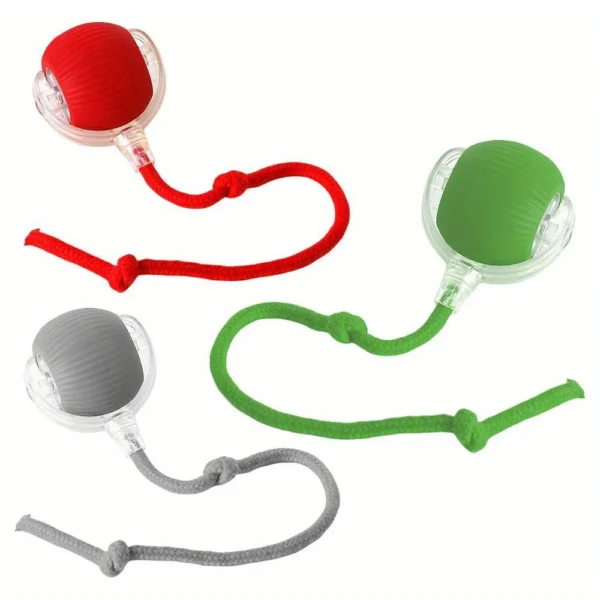
Shoppers comparing rechargeable moving toys can review the automatic interactive cat ball from PinPets. Use the details shown on the product page to evaluate its listed modes, charging information, materials and intended use against your cat’s routine.
For a broader play, walking, rest and travel checklist, see our guide to essential pet accessories for dogs and cats.
Compare Interactive Cat Toys
- Smart interactive rolling cat ball with pouch — rechargeable movement, three modes and hide-and-seek play.
- Over-the-door hanging cat toy — a non-electric option for reaching, swatting and independent play.
- Foldable Magic Organ cat toy and scratcher — combines a ball track with a reshaped scratching surface.
- Catnip chew toy with bell — a hands-on toy for supervised biting, pawing and carrying.
Frequently Asked Questions
Are interactive cat toy balls suitable for every cat?
No single toy suits every cat. Some enjoy automatic movement, while others prefer manual toys or human-led play. Introduce the toy gradually and follow your cat’s response.
Can I leave an automatic cat ball running unattended?
Follow the product instructions and supervise initial use. Regularly check the exterior for wear, and remove damaged toys or loose pieces immediately.
How often should I use an interactive ball?
Use short sessions based on your cat’s interest. Rotate the ball with other appropriate toys and activities so play remains varied rather than repetitive.
What if the toy stops moving on carpet?
Performance can vary by surface. Review the product guidance and test it in a clear area. A toy designed for smooth flooring may move differently on thick carpet.
Interactive Cat Toy Ball Features to Compare
An Interactive Cat Toy Ball can add movement and variety to supervised enrichment. Compare diameter, movement patterns, speed settings, charging method, noise level, materials, and recommended floor surfaces. Check that the product is appropriately sized for your cat and review all operating and care instructions before use.
Introduce an Interactive Cat Toy Ball gradually. Some cats engage immediately, while others need time to observe it from a comfortable distance. Begin with short sessions, supervise initial play, and stop if the movement appears to cause distress. Provide quiet resting areas and rotate toys rather than leaving one activity available continuously.
Charging, Cleaning, and Safe Use
Follow the manufacturer’s charging guidance and keep cables out of reach. Inspect the casing and moving parts before each session. Do not use a damaged toy, and clean it only as directed. An Interactive Cat Toy Ball is an enrichment item and does not replace interaction, rest, or veterinary care.
Browse the PinPets cat-toy collection for current product specifications and availability. The ASPCA cat-care resources provide broader information about responsible feline care.
Before choosing an Interactive Cat Toy Ball, confirm current dimensions, materials, operating modes, care instructions, and availability on the product page. Select a design that suits your cat’s size, activity level, and usual play area.